|
Black
Chefs' Struggle for the Top
Joyce Dopkeen/The New York Times
A matter of pride: Matthew Raiford's father did not want him
to be a chef.
By
MICHAEL RUHLMAN
Published: April 5, 2006
MILTON GUZMAN arrived in the kitchen of Alinea, an avant-garde
restaurant in Chicago, with a prestigious culinary degree
and a sterling recommendation from the New York restaurant
Per Se.
Phil Mansfield for The New York Times
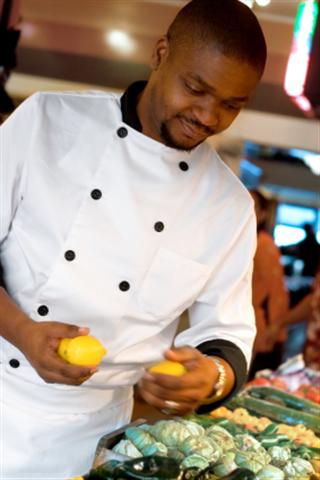
Beyond Fried Chicken: Keith Williams, left, said he jumped
at the chance to be the executive chef at BG in Bergdorf Goodman.
Lloyd Roberts is his executive sous-chef.
He didn't feel he had truly made it, though, until the freezer
broke down several months after the opening. Forced to remake
a tray of melted confections as dinner was about to begin,
the pastry chef, Alex Stupak, asked Mr. Guzman to spray a
tray of newly frozen ganache with liquid chocolate, a technique
requiring such speed and finesse that Mr. Stupak always did
it himself.
Mr.
Guzman, now 29, remembers that as he watched the chocolate
receive layer upon layer of cocoa-butter mist from his paint
gun, he was proud: he felt he truly belonged. But he still
knew that he stood out from the rest of the staff. He was,
once again, the only black chef.
Before
going to Alinea, he had been the only black chef at Per Se.
And at the French Culinary Institute in Manhattan he had been
the only black student in his class. "Why is that?"
he wondered. "Where are they?"
Years
ago, when cooking at even the best restaurants was considered
menial labor, blacks often worked the stoves. But as employment
options opened up for blacks in the 1960's and 70's, kitchen
work became less attractive. Now, with the restaurant industry
booming and chefs becoming celebrities and wealthy entrepreneurs,
few blacks are sharing in that success, and as young black
men and women enter the profession they are finding few mentors
or peers. "The adulation that the chef gets now and the
rank that chefs are on the social scale now, African-Americans
are not taking part of it at all," said the chef and
cookbook author Jacques Pépin.
Ask
any professional cook to name one black chef other than Marcus
Samuelsson, at Aquavit in Manhattan, and you're likely to
hear silence, followed by a nervous chuckle. That was Mr.
Guzman's response.
Mr.
Samuelsson said that blacks fill the ranks of lower-paying
and nonmanagement positions in kitchens throughout the industry,
"but not in the fine-dining community."
"The
sadness of it," he said, "is I can mention every
black chef on one hand."
Interviews
with dozens of black chefs and restaurateurs revealed that
struggles with family members, struggles with employers and
struggles with themselves have all contributed to the scarcity.
Mr.
Guzman said that when he told his family in 2003 that he was
leaving his job as a client manager for ACNielsen after six
years to become a chef, his parents "thought I was taking
a step backward."
"I
don't think cooking, when parents want their children to grow
up and prosper, it's something that comes to mind," he
added. What is more likely to come to mind, in his words,
is "the house Negro" or Aunt Jemima.
That
might be one reason why of 2,700 students at the Culinary
Institute of America, in Hyde Park, N.Y., 85 list themselves
as African-American, up from only 49 in 2001.
One
of those students is Matthew Raiford, who delayed attending
the school for 10 years because his father forbade him to
enter an industry that had virtually no black success stories.
"African-American
parents — our parents — were Pullman porters and
waiters and waitresses," said Mr. Raiford, an Atlanta
chef who has returned to the institute to earn his bachelor's
degree. "Once they had th
e ability for their children not to do that, they didn't want
to choose that."
The
dining rooms of high-end restaurants often hold little more
attraction for African-Americans than the kitchens.
"It's
very common that you go and don't see a single black face
in the entire restaurant," said Alain Joseph, a black
chef in the test kitchen at Emeril Lagasse's headquarters
in New Orleans. "A restaurant with 200 people, you don't
see a single black face."
"If
you never had that exposure to even dine in a fine-dining
restaurant," Mr. Joseph said, "the thought of getting
into the kitchen is greatly diminished."
But
while cultural stigmas have held back many aspiring chefs,
others blame racism. Joe Brown, the chef at Mélange
Cafe, which he owns with his wife in Cherry Hill, N.J., remembers,
at his first job, being choked and called a racial epithet
by the chef. He didn't stay long, but he continued to cook
at numerous other restaurants.
Lance Whitney Knowling, a veteran of high-end Manhattan kitchens
who is now the chef and owner of Indigo Smoke in Montclair,
N.J., said that five years ago he received a call from the
owner of an upscale restaurant in New Jersey to whom he had
sent a cover letter and résumé.
"I'd
have to have somebody like you," Mr. Knowling recalled
the restaurateur's saying. "I couldn't have a black guy
or a Latin guy back there, because it would make my customers
uncomfortable." When Mr. Knowling said he was black,
the restaurateur said, "You're kidding." No, Mr.
Knowling said. The conversation grew awkward, and the restaurateur
apologized.
Even
in questioning a chef's qualifications, employers can reveal
their prejudices.
Keith
Williams, 47, said that he jumped at an offer last year to
be executive chef at the chic restaurant BG at Bergdorf Goodman
in Manhattan, but that job discussions in the past had been
less pleasant.
"The
first thing they say is, "The only thing you know about
is fried chicken and collard greens,' " Mr. Williams
said. "And anybody you know that's in this business that's
a black chef — in most cases that's what he's cooking.
Even if he came out of a French kitchen, he ends up cooking
Southern food."
Mr.
Knowling pointed to his own experience: "I'm classically
French trained. I wanted to be the French chef, and that's
what I studied for years and years, and now I run a barbecue
restaurant — an upscale barbecue restaurant and soul
food restaurant."
Black
chefs aren't the only workers to deal with insensitivity in
restaurant kitchens, where abuse can be freely ladled out
when the pressure gets high. Countless numbers of Hispanic
workers have advanced through the ranks in top kitchens in
the face of slurs and prejudice. And women have braved flagrant
sexism that was once endemic in the male-dominated kitchen.
But black chefs say the abuse raises especially sensitive
questions of respect.
Lloyd
Roberts, 31, who is Mr. Williams's executive sous-chef at
BG and is Jamaican, said his fellow black graduates of the
New York Restaurant School are not comfortable facing that
sort of abuse when they are the only blacks. "It's hard
for African-Americans who were born here," he said.
"It's
as if the chef is picking on them," he added, "when
in reality he's not."
That's
not much of an issue for restaurants if they've had few black
employees.
"We
have had very few African-Americans apply for cooking positions
over all in the 18 years I've been at Zuni Cafe, out of what
I'd guess is thousands of applicants," said Judy Rodgers,
the executive chef of the restaurant, in San Francisco.
The
chef Tom Colicchio said there were few blacks in his kitchens,
including those at Gramercy Tavern and Craft. "Those
roles are not being filled," he said, "and we're
not getting the applications."
And
since many applicants hear of opportunities through word of
mouth, the scarcity can be self-perpetuating.
"For
you to move up in this world, it's not just talent anymore;
it's who you know," said Walter King, 36, a 1990 graduate
of the Culinary Institute of America who left the professional
kitchen in frustration several years ago to work in New York
real estate. "And there's not enough of us in high positions
to play the 'who you know' game."
One
person in a high position who has helped blacks to succeed
is Jean-Georges Vongerichten, whose restaurants have been
incubators for the careers of several talented black chefs.
Sylva Senate and Greg Gourdet are chefs de cuisine at two
of Mr. Vongerichten's places, Mercer Kitchen and 66, respectively.
Mr. Williams and Mr. Roberts of BG both rose at Vong, as did
Charlene Shade, who has just been hired as executive chef
at the Morgan Dining Room and the Morgan Cafe, which are to
open soon at the Morgan Library. And moving up through the
ranks of Jean Georges is Preston Clark, a son of Patrick Clark,
who gained famed at Tavern on the Green. Patrick Clark, who
died in 1998 at 42, was one of the first bona fide celebrity
chefs and a role model for many, black and white.
Even
with the difficulty of advancement, some successful black
chefs say that, for younger blacks, the rewards are now clearly
worth the struggle. As Gerry Garvin, who started as a dishwasher
in his hometown, Atlanta, and is now host of the cooking show
"Turn Up the Heat With G. Garvin" on the TV One
network, put it: "I heard everything you hear when you're
a young black child coming into a culinary world where it
was 90 percent European and a few white guys from Jersey.
You can ride that culinary horror story of racism, and it
doesn't go much further. Or you can embrace it, realize it
happened and try to make it different for guys who are coming
into the business, particularly young black males, and teach
them how to get past the things I had to deal with."
Richard Grausman, president and founder of the Careers Through
Culinary Arts Program, which has headquarters in New York
and provides scholarships and guidance for high school students
interested in culinary careers, said the new acclaim for chefs
in general is helping to breach the barriers.
At
first, Mr. Grausman said, "when I saw somebody had talent,
they might say, Yes, but my mother doesn't want me to, or
my family doesn't want me to."
"That
prevailed up until the last few years," he continued,
"when the explosion of food and chefs' success has come
through the Food Network and other TV shows. So that now I'm
not hearing that. I haven't had resistance from family to
let their kids pursue a career. The floodgates haven't opened,
but that resistance doesn't seem to be there any longer, which
is a big, big plus."
As
at the Culinary Institute of America, the black enrollment
at the French Culinary Institute has risen by about half since
2002. Of the approximately 480 students, 35 to 40 are black,
said officials at the school, who attributed much of the increase
to scholarships from Mr. Grausman's program.
One
of those scholarships was won by Janise Addison, 19, of Corona,
Queens, who graduated from the institute last year. She worked
first at Town in New York; then, through word of mouth, she
found her current job as a pastry chef at the Modern.
"You
make it based on what you can do or can't do," she said
recently at the restaurant before beginning her shift.
After
graduating from Stanford, Beth Setrakian, 49, got her first
job as a pastry chef in 1979 for Mark Miller at the Fourth
Street Grill in Berkeley, Calif., where, she said, "I
was definitely the only African-American in the kitchen."
She opened her own business, Beth's Fine Desserts, in San
Francisco in 1988; she said it now has annual sales of around
$8 million.
"There
are so many black cooks," she said, adding: "We're
on the verge of change. And thank goodness, because the heritage
that we bring is a great addition to American cuisine as a
whole."
|