|
Ancient
Egyptains
By The Clegg Series (Ma’at)
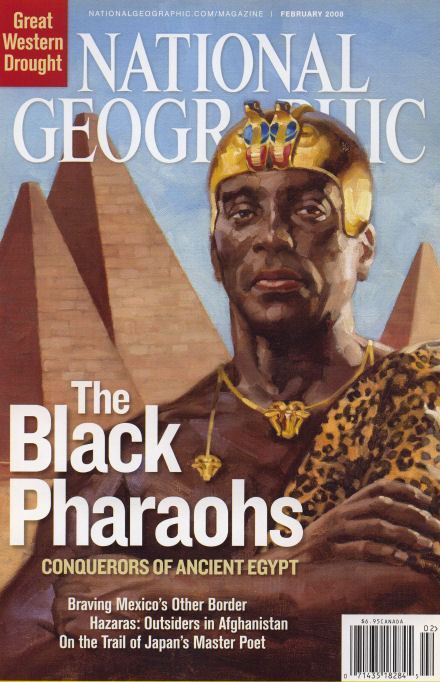
There is a major point of contention over whether the Ancient
Egyptians were Black Africans. It is quite understandable
that this issue would stir up heated passions. For nearly
two hundred years now, White scholars have removed Black people
from Egypt, Egypt from Africa and Africa from world history.
They have always taught that Egypt is in the Near East, the
Middle East, the Mediterranean and even the Fertile Crescent.
They have never informed the world that Egypt is and always
has been on the Continent of Africa.
While
White publishers controlled everything written and taught
about Africa - - and often published books stating that the
Ancient Egyptians were White - - no one, except Black people,
complained. However, since Black people began publishing their
own work and using the internet to tell our story, suddenly
everyone is interested in setting Black people straight by
insisting that the Ancient Egyptians were neither Black nor
white, but Arabs, like the Arabs of today.
We disagree. Arabs invaded Egypt in the 7th Century AD, long
after Ancient Egyptian civilization had declined and faded
away. Arabs have no more connection to Ancient Egypt than
Europeans have to Ancient America.
Many
have argued that, even if the Ancient Egyptians were Black
Africans, modern African Americans, who lay claim to Egyptian
civilization, are not akin to them because their ancestors
were West Africans. This reflects a lack of knowledge about
African history. Virtually all West African people trace their
ancestry to the northeast and ultimately to the Nile Valley.
A number of Black scholars have revealed evidence of the ancient
migratory trail from the Nile across the continent to West
Africa and the Atlantic Ocean. Therefore, modern African Americans
do indeed have a direct link to the Ancient Egyptian people.
We understand that most White people and Arabs have great
difficulty imagining Black Africans to have laid the foundation
of civilization. We sincerely regret that Western racist propaganda
has so narrowed their worldview. But, at this site we deal
with evidence - - not propaganda, not passion, not preconceived
notions or white supremacy.
In
our bi-monthly MA’AT newsletter, we present evidence
that the main-stream media will not touch, because it would
destroy racist myths that have been embraced as inviolable
truths by millions around the world. If you find this site
to be at variance with your sacred belief system, please avoid
visiting us. After all contrary opinions prevail in most other
forums. Why not express your views on those sites where you
may comfortably reassure people of like mind?
In the meantime, for those of you who chose to study, evaluate
and critique the Africentric perspective on the origin of
the Ancient Egyptians, we invite you to visit the February,
1997 issue of MA’AT. This monumental document presents
a substantial body of evidence that conventional scholars,
both Arab and European, choose to ignore.
Many
Black scholars have presented the Africentric view on the
"race" of the Ancient Egyptians. Their research
has triggered a reevaluation of certain assumptions. For example,
most Black Africans do not have thick lips and broad noses.
There are four distinct Black African physical types. All
were part of the Ancient Egyptian population. Secondly Ancient
Egyptian drawings were largely conventional. This means that
they clearly had a symbolic meaning that was not true to form.
For example, the traditional reddish brown color used to portray
all men (no matter what their true skin tone) may have represented
the African "blood of life" concept. For religious
purposes, Black Africans have painted their bodies red or
reddish brown from time immemorial.
Therefore, one should not reach hard and fast conclusions
about Egyptian ethnicity based on the color used in the tomb
and pyramid drawings. Furthermore, even if the colors are
accurate depictions of the people, a number of indigenous,
unmixed Africans, like the Pygmies, have reddish brown skin
tone. Yet no one would deny that these are "Black"
African people. In light of this, if the Ancient Egyptians
were indeed of reddish brown skin color, they were of the
same color as modern Pygmies.
As many writers in the guestbook have attempted to explain,
the original Black Egyptians were mixed with invading Libyans,
Persians, Greeks, Romans, Turks, Arabs and Western Europeans.
This explains the genetic status of the modern Egyptian, who
does not resemble his Black African forebears.
To
truly determine the Ancient Egyptian "race," one
must consider the full range of linguistic cultural, anatomical,
archaeological and genetic evidence. One recent, nonblack
scholar, Richard Poe ("Black Spark: White Fire: Did African
Explorers Civilize Ancient Europe") (Prima Publishing,
Rocklin, CA), has done just that and has reached the following
conclusion: "Were the Egyptians black? That is entirely
up to up to you. But were they biologically African? It would
seem that they were."
We, of course, believe that the Ancient Egyptians were Black
Africans and the following is a synopsis of some of the evidence
that supports our view:
1.
Evidence from Physical Anthropology
The skeletons and skulls of the Ancient Egyptians clearly
reflect that they were a Negroid people with features very
similar to those of modern Black Nubians and other people
of the Upper Nile and of East Africa.
2. Melanin Dosage Test
Egyptologist Cheikh Anta Diop invented a method for determining
the level of melanin in the skin of human beings. When conducted
on Egyptian mummies in the Museum of Man in Paris, this test
indicated that these remains were of Black people.
3.
Osteological Evidence
"Lepsius canon," which distinguishes the bodily
proportions of various racial groups categories the "ideal
Egyptian" as "short-armed and of Negroid or Negrito
physical type."
4.
Evidence From Blood Types
Diop notes that even after hundreds of years of inter-mixture
with foreign invaders, the blood type of modern Egyptians
is the "same group B as the populations of western Africa
on the Atlantic seaboard and not the A2 Group characteristic
of the white race prior to any crossbreeding."
5. The Egyptians as They Saw Themselves
"The Egyptians had only one term to designate themselves
=kmt= the negroes (literally). This is the strongest term
existing in the Pharaonic tongue to indicate blackness; it
is accordingly written with a hieroglyph representing a length
of wood charred at the end and not crocodile scales,"
singular. ‘Kmt’ from the adjective =kmt= black;
it therefore means strictly negroes or at the very least black
men. The term is a collective noun which thus described the
whole people of pharaonic Egypt as a black people."
6.
Divine Epithets
Diop demonstrates that "black or negro" is the divine
epithet invariably used for the chief beneficent Gods of Egypt,
while the evil spirits were depicted as red.
7.
Evidence From the Bible
The Bible states that "…[t]he sons of Ham [were]
Cush and Mizraim [i.e. Egypt], and Phut, and Canaan. And the
sons of Cush; Seba, and Havilah, and Sabtah, and Raamah and
Sabtechah." According to Biblical tradition, Ham, of
course, was the father of the Black race. "Generally
speaking all semitic tradition (Jewish and Arab) class ancient
Egypt with the countries of the black."
8. Cultural unity of Egypt With The Rest of Africa
Through a study of circumcision and totemism, Diop gives detailed
data showing cultural unity between Egypt and the rest of
Africa.
9. Linguistic Unity With Southern and Western Africa
In a detailed study of languages, Diop clearly demonstrates
that Ancient Egyptian, modern Coptic of Egypt and Walaf of
West Africa are related, with the latter two having their
origin in the former.
10.
Testimony of Classical Greek and Roman Authors
Virtually all of the early Latin eyewitnesses described the
Ancient Egyptians as Black skinned with wooly hair.
|